Showing posts with label 1970s. Show all posts

Tuesday, July 19, 2011

In Rotation - Nancy Holloway


This week at Pearl Modern we have been listening to the song stylings of Nancy Holloway. We first discovered Nancy Holloway while we were in Paris for an exhibition. We heard her rendition of the Little Anthony and the Imperials song "Hurts So Bad" on the amazing compilation album "Mélodie En Soul Sol Paris 70's" and were totally blown away.


Below is the song "Hurt So Bad" from Nancy Holloway from its original appearance on her classic album "Hello Dolly".


Nancy Holloway was born in Cleveland, Ohio in 1932. She briefly lived in New York City in her late teens and early twenties, doing odd jobs for little pay. In 1954, at the age of twenty two, she made the courageous and correct decision to move to Paris. One evening at the jazz night spot the Mars Club, she was dared to sing on the stage. Her performance was so well received by the audience that she was offered a regular singing slot at the club.


Below is a clip of Nancy Holloway in a club performing "Prends garde à toi" in 1964.


Holloway toured frequently through Europe and the United Kingdom and ended up performing at the famous Moulin Rouge. In 1963, she signed with Decca and released a number of excellent albums. Nancy Holloway was popular in Europe because she charmingly sang American songs specifically for the French market, mainly sung in French, but with an unabashedly American accent. She had many cameo appearances in French films and appeared on countless magazine covers.


Beneath is the song "Désappointée" from the above Decca release from 1963.


In closing, a wonderful song entitled "As Long As He Needs Me" from the album "Hello Dolly" from 1969.

Tuesday, July 5, 2011

Drama In The Street: The Art Of Window Display


We believe that window display designers are unsung heroes in the history of artistic expression and commerce. The genius of the window designer is the ability to utilize their vast knowledge of theater set design, sculpture, installation art, conceptual art and engineering and distill it into a moment where time is stopped, that evokes fantasy and wonder or is simply a meditation on aesthetics. The responsibility of the window designer is great because their creation will receive infinitely more views than any great master in a museum will on a daily basis.


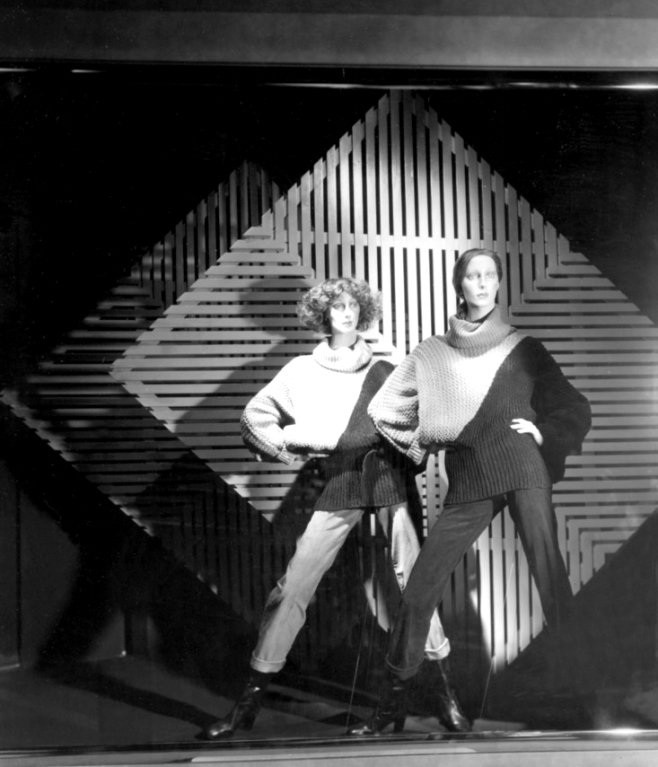
Windows can be sleek tableaux, pure spaces devoid of spectacle where impossibly tall, aquiline, perfectly painted and coiffed mannequins seem to hover magically in their shiny new heels. They are dressed in the newest, just off the runway ensembles and perfectly accessorized. These tableaux are the window designer's genius visions, meant to appeal to the competitive shopping natures of the sophisticated and monied.


Below is a window display at Barney's, New York City in 1986, designed by Simon Doonan and Sandy Skoglund.


Great, memorable window displays may be the yearly Christmas extravaganzas, decked out with animatronic characters, a lifelike herd of reindeer, who turn their heads from side to side, their googly eyes glazed hypnotically by twinkling lights. They might be windows that have been magically transformed into jungles or some faraway exotic place, with mannequins sporting the newest khaki safari garb, perfect for the urban jungle.

The best window designers are chameleons who understand their viewers from the very old to the very young, whether it be Macy's winter wonderlands or the fantastic inventions of Simon Doonan in the windows of Barney's New York. 


When pulling together images for this post, we were most drawn to window displays from the past that exhibited a quiet emotion, almost cold. Historically, many window displays have been purely corporate, with the signage of the business front and center, such as in the image above from 1957, advertising the new, state of the art General Electric appliances. The female mannequin protagonist, portraying the prototypical housewife, electric beater in hand, is caught, most likely in the moment of baking a cake. She is alone in her domain, a space perfectly designed, down to the speckled linoleum, so popular that year.


In the next images, we would like to share some photos we discovered while digging for materials in Switzerland. These are photos from Gebrauchsgraphik, 1967, of window displays for the Hermès, Paris, Faubourg Saint-Honoré store, designed by Annie Beaumel. 
 
In 1927, Annie Beaumel began her career designing gloves for Hermès and then gradually morphed into perhaps the greatest, most eccentrically visionary of all window designers. Her work was surreal, anthropological and wildly sophisticated. Her designs for Hermès were so amazing that she received letters from the public thanking her for her "drama in the street".