Showing posts with label Pearl Modern. Show all posts

Friday, October 21, 2011

Love Letter to Lacroix


Lately I have been thinking a lot about and collecting French Haute Couture from the mid 1980s to the late 1990s. The Paris runways are always decadent and über glamorous, but this particular time period bore fashions that were particularly Baroque in their luxe. Of course, Karl Lagerfeld at Chanel is an obvious example, with his icy elegance as are Galliano and McQueen, but lately I've been obsessing on Christian Lacroix and his legacy of fantastical creations that summed up that era with an exuberant joie de vivre. 


I first fell in love with the designs of Christian Lacroix as a young girl, hungrily flipping through fashion magazines. I recall the first image was of his iconic silver haired model/muse Marie Seznec in a giant poufy skirt and laced bodice, a dizzying cross between a towering strawberry shortcake and Marie Antoinette on hallucinogens. 


Unlike other designers, whom you practically need a chisel to crack through the impenetrable façade of reserved sophistication and cool, with Lacroix's creations you are invited into the fantasy to revel at the technicolor plumage, exotic patterns that rhapsodically clash in the most brilliant way, all tied together with endless ropes of sparkling rhinestones. 


During Christian Lacroix's runway extravaganzas, the models would invite you in to their cabaret with cheeky rouged smiles and flirty glances, making the clothes seem extra sexy, approachable, even touchable. Wearing Lacroix, you would be the life of the party or even the party itself, decked out like an iced pink champagne cake.


Next is a fantastic early Christian Lacroix runway show from 1988.


In the above video at 1:55 is a model in a yellow and black jeweled bustier with a canary yellow chignon who is wearing the large Christian Lacroix gold cross necklace that we are currently featuring in the Pearl Modern store.


                                                                                 available here


Below is an incredible black and gold ensemble from 2007.      


An artistic masterpiece from 2009.

Below, a gorgeous Baroque brooch by Christian Lacroix!

                                                                                                                 
                                                                                                                                           available here


Next, we have a Christian Lacroix runway show from the Fall/Winter of 2002/2003.


I truly miss Christian Lacroix and the magic he created every Spring and Fall. He was a master couturier at the highest technical level, but most of all, he was a genius visual artist, a painter whose media was the lightest tulle, the richest velvet and the most divine feathers. 

In closing, we have a tremendous Christian Lacroix runway show from 2003.


Saturday, August 6, 2011

Collecting Hats Is Serious Business - 60's Mod


We at Pearl Modern absolutely adore mod style. We are attracted to the sharp architectural cuts, clean lines and futuristic optimism present in clothing and design made in the mid 1960's. Mod style is as radical as punk rock, but in a way that is so distilled that its psychology is elusive to anyone lacking an educated and refined eye. What may look like a simple white coat is actually a complex structure, perfectly balanced in geometry but that sits slightly askew, causing the odd passer-by to look twice and then come to the conclusion that this garment is the most stylish white coat they have ever seen. 

Mod styling incorporates wit and whimsy into the details, for instance, whether you're exaggerating the bend in a brim of a hat to cast a mask-like shadow across the face or by cutting a hem on a radical diagonal or by lining buttons up like a game of tic-tac-toe, just because it looks cool - you are stretching your imagination of what is possible aesthetically, but within the confines of a purist's tent.


Below is a shot from a 1965 space age photo shoot, featuring cutting edge fashion from Pierre Cardin.


As far as hats go, we collect and sell every sort of chic topper from the 1920's through the 1970's, as long as we can imagine wearing them ourselves. For me personally, I get strangely excited when I see an almost abnormally tall, velveteen helmet with a cocky, slightly arrogant brim and a girly, sweet leatherette bow. Call me eccentric, but what could be more fun than wearing a fantasie on the top of your head, perched like a folly, like a canary's cage or simply like a hat that will make that random stranger say "Damn, that hat is awesome".


Below is a sunny, mod 60's Empress Marché exclusive melusine fur felt hat.


Below is a slick, 60's mod take on a classic Trilby as done by Betmar.


                                                                                                                                      available here


Below is an illustration of an Adolfo hat from the 1960s.


Below is a photo of the iconic 60's model Peggy Moffitt.


Below is another 1960s Adolfo hat illustration.
 

Below is a plum velvet bubble hat, made in Italy in the 1960s, exclusively for Marshall Field & Company.
                                                                                                                                       available here


Below is a great photo of Sophia Loren trying on hats in Rome.


Below is a beautiful photo of Jean Seberg from 1969 taken at the time of her film "Pendulum".


Below are two views of an English made 1960's emerald green bubble cloche hat.


                                                                                                                                          available here


Below is a photo of the amazing Faye Dunaway in a giant white hat.


Last, we have a photo from 1963 of a model wearing a Pierre Cardin ensemble with a fantastic graphic hat. Doesn't she resemble a mod Kirsten Dunst?


Tuesday, July 5, 2011

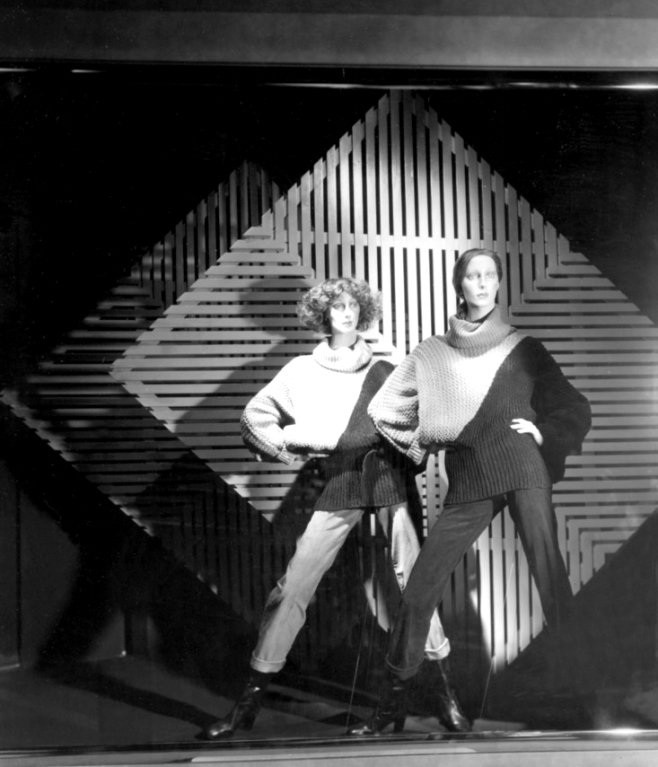
Drama In The Street: The Art Of Window Display


We believe that window display designers are unsung heroes in the history of artistic expression and commerce. The genius of the window designer is the ability to utilize their vast knowledge of theater set design, sculpture, installation art, conceptual art and engineering and distill it into a moment where time is stopped, that evokes fantasy and wonder or is simply a meditation on aesthetics. The responsibility of the window designer is great because their creation will receive infinitely more views than any great master in a museum will on a daily basis.


Windows can be sleek tableaux, pure spaces devoid of spectacle where impossibly tall, aquiline, perfectly painted and coiffed mannequins seem to hover magically in their shiny new heels. They are dressed in the newest, just off the runway ensembles and perfectly accessorized. These tableaux are the window designer's genius visions, meant to appeal to the competitive shopping natures of the sophisticated and monied.


Below is a window display at Barney's, New York City in 1986, designed by Simon Doonan and Sandy Skoglund.


Great, memorable window displays may be the yearly Christmas extravaganzas, decked out with animatronic characters, a lifelike herd of reindeer, who turn their heads from side to side, their googly eyes glazed hypnotically by twinkling lights. They might be windows that have been magically transformed into jungles or some faraway exotic place, with mannequins sporting the newest khaki safari garb, perfect for the urban jungle.

The best window designers are chameleons who understand their viewers from the very old to the very young, whether it be Macy's winter wonderlands or the fantastic inventions of Simon Doonan in the windows of Barney's New York. 


When pulling together images for this post, we were most drawn to window displays from the past that exhibited a quiet emotion, almost cold. Historically, many window displays have been purely corporate, with the signage of the business front and center, such as in the image above from 1957, advertising the new, state of the art General Electric appliances. The female mannequin protagonist, portraying the prototypical housewife, electric beater in hand, is caught, most likely in the moment of baking a cake. She is alone in her domain, a space perfectly designed, down to the speckled linoleum, so popular that year.


In the next images, we would like to share some photos we discovered while digging for materials in Switzerland. These are photos from Gebrauchsgraphik, 1967, of window displays for the Hermès, Paris, Faubourg Saint-Honoré store, designed by Annie Beaumel. 
 
In 1927, Annie Beaumel began her career designing gloves for Hermès and then gradually morphed into perhaps the greatest, most eccentrically visionary of all window designers. Her work was surreal, anthropological and wildly sophisticated. Her designs for Hermès were so amazing that she received letters from the public thanking her for her "drama in the street".


Saturday, June 25, 2011

Paper Dolls In Paradise

As a young fashion obsessed girl growing up in a small California enclave, I took my fashion where I could get it. 

Raised by a single working mother, I entertained myself after school at the library, pulling great stacks of photography books, books on fashion photography such as "Scavullo's Women" and books by Irving Penn, David Bailey, Horst, et cetera. I read every art book I could get my hands on. I even read whole sets of encyclopedias from Brittanica to the How-To library. I have always been almost pathologically image obsessed. 


In a need to overcome adolescent boredom, I one day adventured into a sewing supply store, and walking past the spools of technicolor thread and endless skeins of yarn, I discovered a new library. On a large wooden table, there was one massive volume after another, laid out with names like "Butterick", "Simplicity", "Vogue", "McCalls"... a pattern book revelation!


In these volumes, there were drawings of cute, button nosed girls with dark eyes and high ponytails wearing frilly, fun dresses in crazy patterns and bell bottoms with t-shirts sporting slogan patches. All of the girls had tan skin, the color of butterscotch. 


The Vogue pattern books were so elegant, with sophisticated ladies dressed in sharp looking suits and glittering gowns. They wore wild hats and big jewelry and had expressions on their faces of haughty dissatisfaction, as if they were thinking that they would rather be drinking champagne on a yacht. 

These pattern books were full of endless fashion possibilities. One could look like a Disney princess or a hippie chick in a patchwork poncho and leather short-shorts. The illustrations for the most part were very accessible, not the flamboyant fantasies of a couturier designing dresses for only the gilded few. These were drawings of girls one could actually look like, a feat, of course much more easily accompished if your mother could sew.


Below is a fun Pop-Art romper that was made in Miami in the 1960s.


                                                                                                                                         available here


Below is a fantastic lime green sundress designed by Oleg Cassini in the 1960s.


a                                                                                                                                        available here


Below is an adorable pink gingham party dress from the 1960s.


                                                                                                                                           available here


If you have any early fashion memories that you would like to share with us, please do!